Reradicalization

Reradicalization
 met a new friend one day as I walked through a farmers’ market that sprawled throughout the streets of our city. I walked past a Seventh-Day Adventist named John who called out to passersby in order to take advantage of the foot traffic for evangelizing. I decided to go ahead and give him the time of day and listen to what he had to say. I had nothing to lose, after all, so why not listen? He gave me a book titled “The Next Superpower” and mentioned that their sect of Christianity focused highly on end-times which the book also discussed. We talked briefly and I went on my way thinking little of it.
I had always been fairly interested in the end-times discussion and I had even read through Tim Lahaye’s and Jerry Jenkins’ Left Behind series even though I did not exactly agree with their vision of how it would play out. I had done a lot of studying of Revelation and the other prophecies and I had my own beliefs about it all, but there was no telling if any of my interpretations were right or wrong given all the symbolism and the seemingly misaligned timelines. I looked forward to reading this new book to see if it had any insights that I could use for my own understanding. I found myself rather engrossed in the book. I read it in only one or two days. While I certainly took much of it with a grain of salt, it did indeed have a few good points. It talked in great detail regarding the evil of the Catholic Church and how Seventh Day Adventists came to the conclusion that the organization of Catholicism is actually the prophesied antichrist.
For the most part, I thought the arguments were pretty well laid out. It did not entirely convince me, but I certainly kept my eyes and mind open to determine if this could indeed be true. While I really enjoyed the insights and evidences for the evils of the Catholic Church and aligning it with prophecies of the anti-Christ, the book failed miserably when it came to the mark of the beast. It proclaimed the mark to be that of holding church services on Sundays rather than on Saturdays. It ignored the fact entirely that the mark needed to be the name or the number of the beast, 666, and that it would be placed on the left hand or forehead of the person aligned with the beast who would then be damned to destruction. One could also not buy or sell without the mark of the beast. How this book could come to this hideous and outrageous, intellectually insulting conclusion that Sunday services could be this mark, was beyond me. One must worship on Sunday to buy and sell things? One must wear Sunday worship on their forehead? It made no sense at all.
Perhaps the author thought that if he had enough logical arguments at the beginning of the book then he could just throw something in and have it believed unquestioned. It certainly did not work for me, and I really do not understand how anyone can believe this to begin with let alone hope to convince others. It is easy enough to believe that God wants Saturday worship to continue, but not that Sunday worships is the mark of the beast found in Revelation.
I went and found John’s email from the church website and I began communicating with him about the book. I gave him my take on it and how I found it interesting and plausible apart from the mark of the beast. I also assured him that I thought it made more sense to worship on a Saturday since that was indeed the original Sabbath day, but not that everyone was damned to hell if they did otherwise. After all, Jesus himself had said that the Sabbath was made for man and not man for the Sabbath which pretty much nullified any power it could have to damn someone to hell for not adhering to it.
I liked John, though, despite the foolish conclusion. We got together regularly throughout most of the rest of my faith up until the time I made the most heretical conclusion ever. I visited his church and met his people. I did so mostly with the intention of making a good impression of myself so as to be more trusted and respected. I wanted to be able to discuss things logically with anyone and everyone who might be willing to look beyond traditions and instead determine how best to make a true church that would be organized by God himself. They were all very good people who cared for one another as much as I could tell in a couple hours of knowing them. They had regular meals with each other and cared for the poor like the Bible demands and like real church should do. I really enjoyed them, but I simply could not sign up with their dogma regarding the Sabbath being so important. Love is important—not the Sabbath.
Since I had yet to find a church that seemed to be doing things right according to God from my understanding, I began considering in greater detail what church ought to be. I studied what the early church looked like in the book of Acts and other key parts of the Bible and I compared that against what we actually had for church today. I first noticed that the church found in Acts did not own their own building. They met in public spaces—free spaces—spaces paid for by taxes rather than by tithes. They did not even tithe at all since they shared everything they had. They sold their greatest possessions including their homes in order to give the money to those in greater need. They certainly did not pay for a pastor. The people focused on each other and helped each other in every way with no particular leader apart from God himself and his edict to love. This should not be some strange, one-time event; this is the very church that Jesus set out to create. The very church we now lack today.
The early church’s get-togethers centered around eating meals with each other as opposed to ritualistically eating quarter-sized flesh and sipping on a thimble of blood once a month. They met on a daily basis and lived life together as a giant family rather than merely meeting once a week or perhaps only on Easter and Christmas like some terrible anti-social club.
No one led anyone else in the early church; individuals spoke messages as the Spirit came upon them and they all reasoned together whether or not it came from God. They would each contribute their own unique gifts of the Spirit as God doled them out. In fact, this sounds like what Jesus had intended when he said in Matthew 23:8 to call no one teacher. He explained that we all have the same teacher and that we were all brothers. In other words, we were all equal and revelation should come from God alone—not from man.
This early church actually had the power of healing, prophesying, and speaking in tongues unlike all those fakers pretending they do. Seeing these contrasting differences, I came to the conclusion that if we actually did things properly (i.e. fanatically, selflessly, daily, and with a desire for actual obedience to God directly), then God would again reward our faithfulness in power. We needed life-long commitments to a communal setting dedicated to one another rather than semi-committing to weekly church clubs that make us feel special.
I decided then that I would no longer attend churches. I figured God did not ordain them since they were run by man and they hindered the progress of true faith. I found churches guilty of the same crimes of which Jesus accused the Pharisees, “Woe to you, teachers of the law and Pharisees, you hypocrites! You shut the door of the kingdom of heaven in people’s faces. You yourselves do not enter, nor will you let those enter who are trying to.” I developed the following chart as I studied and compared the church of God to the church of man and I stood in awe at the stark contrast.
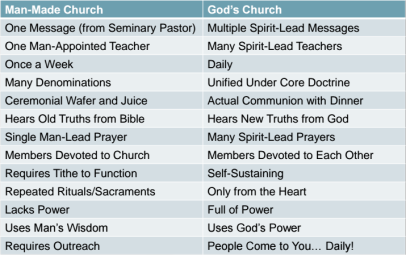
With my new-found knowledge, I began contemplating the idea of holding my own seminar to enlighten the masses. I also considered making a viral YouTube video with all my revelation. I had little experience in such things and I had no idea how to get people to attend or to watch such a video, but it seemed like a really good idea—apart from my lack of personal skills and presentation skills, of course. I recorded myself practicing a 34-page PowerPoint presentation which I had thrown together. It discouraged me beyond hope. I hated my voice, I hated my inflections, I hated my tone, and I knew I would not be reaching anybody with a presentation so dull and drab as this. I failed so exceedingly to inspire motivation even within myself that I knew it would not be worth my time. People would fall asleep before they could even hear any point I was trying to make. My efforts, yet again, fell short and vain. I had unmistakably not been given the gift of teaching nor apostleship. I could not rally people around a bucket of ice cream let alone around a message of dying to self and living for others.
I then thought about turning my presentation into a book. I began writing about how terrible Christianity was and how everyone sucked at fulfilling the command to love. I explained that everyone missed the point, lived entirely selfish, and loved only their navels. As one might surmise, the tone of such statements did not come off too pleasant which made it quite unlikely to be read and awed. Realizing this, I began to think I could not teach even within a book. I second-guessed everything I wrote and I hated everything after reading it a few times. I could not get anything down that I could actually appreciate. On top of that, I could only ever write a few pages-worth of content before feeling like I said everything I wanted to say. It could hardly be called a book at all. I shared my pamphlety book with a few people in hopes to get some kind of support to keep trying, but given that I spoke against all of Christendom, I did not find any such support. I had to go back to the drawing board.
I thought about Campus Crusade for Christ and how it engaged the students to live out their faith and gave everyone the opportunity to participate and give talks unlike at a church. It felt much closer to the church of the Bible than our modern-day churches even if still being quite far from it. I decided to attend Crusade at a nearby college in order to see if I could participate. I had hoped that perhaps my personality, when engaged face to face with someone, could help them come to my conclusions and then maybe I could find someone else with the gift of teaching or writing that could get my points across better than I. It seemed like a cop-out much like Moses making Aaron speak for him, but I could not think of a better option at the time.
Crusade at Western Michigan University proved quite different from Tech. They actually had staff who did much of the work rather than allowing the students all the pleasure. Despite the disappointment, I did make a new friend my first night there. I told William how I had given up on churches and he assured me that his church, Threads, would change my perspective. I vocalized my lack of faith in his assertion and the foundational disconnect that he is evidently lacking to even assume it as a possibility. No man-made church could match what I now understood church to be. I agreed to give it a try anyway, however, so as not to come off closed-minded and in hopes to ultimately prove my point.
I immediately loved Threads, of course, as I often fell prey to seeing the good in a church by trying to be optimistic and hoping to finally finding the church of my dreams. It is much the same effect where we overlook the faults of a person we find attractive. Threads had a band with less-than-perfect people in it which hinted at more participatory ability and less vanity. The message series actually applied to me and many others as they had just started a series on marriage and raising kids. The people were friendly enough and I could actually approach the pastor without fear of some secret service hauling me off like a deranged fan. Just maybe, I thought, this church would prove different and maybe it would be open to my insights for the things it yet lacked.
I got my first red flag, however, when I went and spoke with the pastor in private. I explained my hesitancy towards churches in general since I had yet to find one that truly followed God and they often seemed downright corrupt and shady. I explained that, due to my desire to scope out the church first, I would wait on tithing until I could feel certain that it would be a good use of my money. After all, I had already wasted so much on other churches like Radiant and Frontline. Pastor Lee (not the same as Radiant’s Pastor Lee, of course) surprised me with his response and it still surprises me even today. He appeared visibly taken aback and assured me unwaveringly that it would be a terrible idea to wait on giving him my money.
I expected something a tad more tactful like telling me how comfortable he felt with my questioning, or my desire to do what is right. Maybe he could appreciate my lack of accepting a church without testing it out first to ensure it is a Godly church. Such a response would have made me more at ease and might have made me more likely to begin tithing sooner. Instead, he pushed that I ought to tithe immediately. If I did not, it would withhold the blessings of God and it demonstrated a lack of faith on my part. I could not believe my ears, but I gave him the benefit of the doubt that he actually believed this rather than simply wanting my money so badly that he would so boldly demand it. Still, I did not tithe right away which probably set back my odds of being on Pastor Lee’s good list.
Emily and I both attended the church for a while and we tried our best to make friends and participate. Like in many churches, the majority of people were too busy to do much outside of church itself, but we kept at it and we did manage to make a few friends that we would hang out with every so often. Meanwhile, I continued to study the Bible while seeking the power of God for the benefit of all mankind.
I could not find anywhere where the Bible claimed that the power of God should dissipate. I had every reason to believe it still remained. Jesus said we would do greater works than he did which is usually passed off as merely greater preaching or building wells for people rather than actual miracles like he performed. As far as everyone else was concerned, greater works could mean anything except the power of God since that obviously no longer existed. It always made me wonder why people even bothered praying for healing in the first place. Did they believe in the power or not?
I did not give in so easily to this interpretation of a powerless faith, of course, since Jesus directly juxtaposed his works of miracles with ours. He healed people, casted out demons, walked on water, and then said “Very truly I tell you, whoever believes in me will do the works I have been doing, and they will do even greater things than these.” Paul had been shipwrecked multiple times so clearly he could not calm seas nor walk on water. The greater miracles had yet to come. I kept coming back to our unworthiness and wondering how I might make myself worthy to bear the torch and show everyone the power since they would not merely listen to me without it.
As I studied, I began to recognize the concept of a poor spirit. Twice in the gospels, Jesus is recorded as saying, “Blessed are the poor in spirit for theirs is the Kingdom of God.” Perhaps we had to have a spirit of poverty to receive the power of God. Similarly, many other verses indicated worldly lust and riches as being a hindrance to the kingdom. Those who followed Jesus often left everything, sold everything, and followed him. There were parables about selling everything so as to buy the precious pearl or the treasure which were analogous to the Kingdom of God. I began to believe that perhaps I had too many worldly possessions. Maybe I did not yet show enough radical faith for the power. Sure, I had already lived quite poor in the past, but I also did not have as much understanding as I did now. And perhaps God wanted me to fail on my own power first to really drive home the need for his.
I did not hesitate or flinch upon reaching this conclusion. I knew that I would have to be like the many people who followed Jesus by selling everything and living for the poor. It just so happened to be the year of 2009 and the market started to collapse in on itself. People were losing jobs and foreclosing on homes left and right. Emily happened to lose her job at this time and we tried for months to find her a new one. With such a dramatic decrease in income and combined with the insight that we ought to sell everything and live with a spirit of poverty, I decided we ought to allow our house to go into foreclosure. We probably would have been able to pull through on my income alone if we budgeted strictly and lived off Ramen noodles, rice, and potatoes for a while, but it appeared that God set this up perfectly to get us out of it. I felt exceeding pressure from God to get rid of this idol and to achieve his power to save the world—even more emphatically, to save my unborn son.
We had recently found via ultrasound that our upcoming child had a leg deformity called fibular hemimelia. The doctor said he only had a tibia and no fibula in his left leg. The fibula is the smaller of the two bones in the lower leg and his could not be found. The tibia appeared stunted in growth and bent at nearly a ninety-degree angle. We prayed and prayed for healing but our cries were getting lost somewhere—probably in the walls of our house. We needed the power of God and I could not let an earthly possession and a commitment to pay for something as ungodly as a house stop me from getting it. My son would be the first to be healed and it would spark a transformation of the faith that would heal the world and bring about the coming of God and his eternal kingdom. I foresaw Christianity rising up in power and the evil atheists and Muslims rising up against us. The clash would be immense and the return of Jesus would deal the final blow. I could see it coming and it must be that God desired to use me to bring it about since I could not find anyone else who saw all these facts.
People at church were not so happy about our choice to reduce our worldly nature, and Pastor Lee said we ought to fulfill our obligations to the mortgage. If only he understood as I did that worldly possessions are evil, he would not have been so quick to say that I needed to fulfill my obligations to Satan himself. He did not see what I saw. He did not believe in the power of God nor did he put enough faith in the teachings of the Bible. I had to do this to regain the power of God and to heal the world. Emily was not so keen on the idea herself, of course, but I promised her it would all be for the best.
We stopped paying immediately, and we moved into an apartment long before we needed to. We could have stayed in the house for nearly a year without paying a dime, but our goal did not include saving money as much as being rid of worldly idols. We were likely to be giving all our money away anyway so trying to save it to stay in a house that we knew we ought to be rid of seemed rather counterproductive. So we moved right away and paid the financial price for it. Money would prove useless when it came to the power of God anyway. We did not give up a house so much as we gave up our debt and for the great purchase of buying the kingdom of God. What a bargain!
Such a radical decision which defied the advice of the pastor and everyone else around me clearly did not fit in my agenda when I originally came back to God in meekness and trembling, resolute in doing nothing crazy. But since churches could not agree on anything other than the Bible being the word of God, Jesus being God, and Jesus dying for our sins, I had no choice but to use my own brain to determine what the Bible really meant. There was simply too much at stake to pick a church at random and become a sedentary sheep believing all they told me with such a great likelihood that I would pick the wrong one. The chances were too small that I would pick the one church out of thousands that happened to be preaching all the right doctrines.
My brain would be required to determine proper doctrine and unfortunately this is where my brain on “Bible-is-True” drugs led me. I had dedicated myself to seeking, to finding, and to engaging in the truth of God. If this meant anything at all, if God guided such heart-felt effort, then I would have nothing to lose. I would not succumb like the lost lambs around me. I would not be confined by pharisaical pastors. I would not seek only what I wished to hear like a selfish atheist, but I would seek whatever proved true even if it went against all of Christendom. Even if it meant sacrificing my livelihood and that of my family, I would let God be true and every man a liar. I would discover the deep and hidden secrets within the Bible and I would work them out to once again receive the promised power of God. God’s kingdom would be restored!